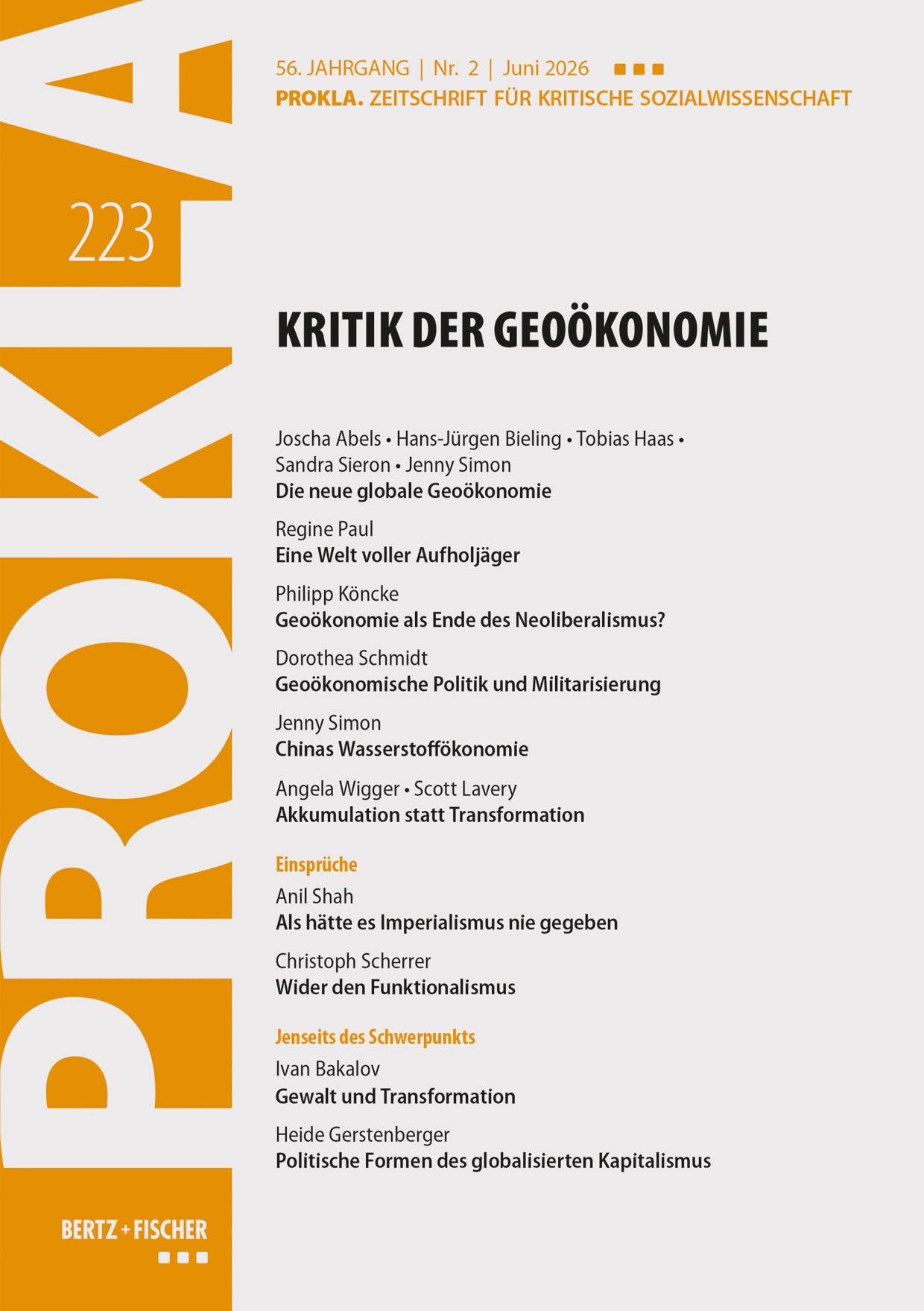
Die neue globale Geoökonomie
Umrisse einer kritischen Perspektive
DOI:
https://doi.org/10.32387/prokla.v56i223.2244Schlagwörter:
Geoökonomie, Geopolitik, globaler Wettbewerb, kritische politische ÖkonomieAbstract
Um die sich zuspitzenden globalen ökonomischen Konflikte analytisch zu fassen, wird in den vergangenen Jahren verstärkt auf das Konzept der Geoökonomie zurückgegriffen. Ausgehend von der Genese des Konzepts identifizieren wir drei Bausteine einer kritischen geoökonomischen Perspektive: Diese adressieren Kontinuitäten und Brüche geoökonomischer Wettbewerbsstrategien mit den Organisationsformen des marktliberalen Kapitalismus, die materielle Verankerung ungleicher globaler Wirtschaftsbeziehungen im Zuge des geoökonomischen Wettbewerbs sowie die zugrundeliegenden Kapitalinteressen und Ausbeutungsverhältnisse. Abschließend werden Ansatzpunkte für eine Kritik der Geoökonomie entwickelt, die im gegenwärtigen Diskurs weitgehend marginalisiert bleiben.Downloads
Literaturhinweise
Abels, Joscha (2024): Private infrastructure in geopolitical conflicts: the case of Starlink and the war in Ukraine. In: European Journal of International Relations 30(4): 842-866. DOI: https://doi.org/10.1177/13540661241260653. DOI: https://doi.org/10.1177/13540661241260653
Abels, Joscha / Bieling, Hans-Jürgen (2022): Jenseits des Marktliberalismus? Europäische Industrie- und Infrastrukturpolitik im Zeichen neuer globaler Rivalitäten. In: PROKLA 208 52(3): 429-449. DOI: https://doi.org/10.32387/prokla.v52i208.2004. DOI: https://doi.org/10.32387/prokla.v52i208.2004
– (2024): The geoeconomics of infrastructures: viewing globalization and global rivalry through a lens of infrastructural competition. In: Globalizations 21(4): 722-739. DOI: https://doi.org/10.1080/14747731.2023.2264667. DOI: https://doi.org/10.1080/14747731.2023.2264667
Abels, Joscha / Bieling, Hans-Jürgen / Kassem, Sarrah (2023): Re‐regulating the European High‐Tech Capitalism? The EU’s Digitalization Strategy at a Turning Point After the COVID‐19 Pandemic. In: Janusch, Holger u.a. (Hg.): Turning Points: Challenges for Western Democracies in the 21st Century. Berlin: 311-334. DOI: https://doi.org/10.1515/9783111272900-015. DOI: https://doi.org/10.1515/9783111272900-015
Alami, Ilias u.a. (2023): International financial subordination: a critical research agenda. In: Review of International Political Economy 30(4): 1360-1386. DOI: https://doi.org/10.1080/09692290.2022.2098359. DOI: https://doi.org/10.1080/09692290.2022.2098359
Allinson, Jamie C. / Anievas, Alexander (2009): The uses and misuses of uneven and combined development: an anatomy of a concept. In: Cambridge Review of International Affairs 22(1): 47-67. DOI: https://doi.org/10.1080/09557570802680132. DOI: https://doi.org/10.1080/09557570802680132
Altvater, Elmar u.a. (Hg.) (1987): Die Armut der Nationen. Handbuch zur Schuldenkrise von Argentinien bis Zaire. 1. Aufl. Berlin.
Babić, Milan / Dixon, Adam D. / Liu, Imogen T. (Hg.) (2022): The Political Economy of Geoeconomics: Europe in a Changing World. London. DOI: https://doi.org/10.1007/978-3-031-01968-5. DOI: https://doi.org/10.1007/978-3-031-01968-5
Babić, Milan (2025): Geoökonomie. Anatomie der neuen Weltordnung. Berlin.
Bloom, Peter (2025): Capitalism Reloaded: The Rise of the Authoritarian–Financial Complex. Bristol. DOI: https://doi.org/10.56687/9781529233872. DOI: https://doi.org/10.56687/9781529233872
Brand, Ulrich / Wissen, Markus (2024): Kapitalismus am Limit. München.
Crouch, Colin (2011): Über das befremdliche Überleben des Neoliberalismus. Postdemokratie II. Berlin.
Dix, Arthur (1925): Geoökonomie. Einführung in erdhafte Wirtschaftsbetrachtung. München.
Dunford, Michael / Liu, Weidong (2017): Uneven and combined development. In: Regional Studies 51(1): 69-85. DOI: https://doi.org/10.1080/00343404.2016.1262946. DOI: https://doi.org/10.1080/00343404.2016.1262946
Farrell, Henry / Newman, Abraham L. (2019): Weaponized Interdependence: How Global Economic Networks Shape State Coercion. In: International Security 44(1): 42-79. DOI: https://doi.org/10.1162/isec_a_00351. DOI: https://doi.org/10.1162/isec_a_00351
Glassman, Jim (2025): Critical geoeconomics, critique of geoeconomics or something else? In: Environment and Planning A: Economy and Space 57(1): 108-112. DOI: https://doi.org/10.1177/0308518X241270015. DOI: https://doi.org/10.1177/0308518X241270015
Hameiri, Shahar / Jones, Lee (2024): Why the West’s alternative to China’s international infrastructure financing is failing. In: European Journal of International Relations 30(3): 697-724. DOI: https://doi.org/10.1177/13540661231218573. DOI: https://doi.org/10.1177/13540661231218573
Harvey, David (2003): The New Imperialism. Oxford. DOI: https://doi.org/10.1093/oso/9780199264315.001.0001. DOI: https://doi.org/10.1093/oso/9780199264315.001.0001
Heldt, Eugénia C. (2023): Europe’s global gateway: A new instrument of geopolitics. In: Politics and Governance 11(4): 223-234. DOI: https://doi.org/10.17645/pag.v11i4.7098. DOI: https://doi.org/10.17645/pag.v11i4.7098
Helleiner, Eric (1995): Explaining the Globalization of Financial Markets. Bringing States Back In. In: Review of International Political Economy 2(2): 315-341. DOI: https://doi.org/10.1080/09692299508434322. DOI: https://doi.org/10.1080/09692299508434322
Leonard, Mark (2021): The age of unpeace: How connectivity causes conflict. London.
Luttwak, Edward N. (1990): From geopolitics to geo-economics: Logic of conflict, grammar of commerce. In: The National Interest 20: 17-23.
Mallin, Felix / Sidaway, James D. (2024): Critical geoeconomics: A genealogy of writing politics, economy and space. In: Transactions of the Institute of British Geographers 49(1): 1-16. DOI: https://doi.org/10.1111/tran.12600. DOI: https://doi.org/10.1111/tran.12600
McNamara, Kathleen R. (2024): Transforming Europe? The EU’s industrial policy and geopolitical turn. In: Journal of European Public Policy 31(9): 2371-2396. DOI: https://doi.org/10.1080/13501763.2023.2230247. DOI: https://doi.org/10.1080/13501763.2023.2230247
Mohr, Catrin / Trebesch, Christoph (2025): Geoeconomics. Kiel Working Paper N0. 2279, Kiel: IfW. DOI: https://doi.org/10.2139/ssrn.5073285. DOI: https://doi.org/10.2139/ssrn.5073285
Moisio, Sami (2024): Towards critical geoeconomics? In: Transactions of the Institute of British Geographers 49(1): e12646. DOI: https://doi.org/10.1111/tran.12646. DOI: https://doi.org/10.1111/tran.12646
Nost, Eric / Goldstein, Jenny E. (2021): A political ecology of data. In: Environment and Planning E: Nature and Space 5(1): 3-17. DOI: https://doi.org/10.1177/25148486211043503. DOI: https://doi.org/10.1177/25148486211043503
Roberts, Anthea / Choer Moraes, Henrique / Ferguson, Victor (2019): Toward a geoeconomic order in international trade and investment. In: Journal of International Economic Law 22(4): 655-676. DOI: https://doi.org/10.1093/jiel/jgz036. DOI: https://doi.org/10.1093/jiel/jgz036
Ruck, Jan / Bieling, Hans-Jürgen (2026): Linking geoeconomic and financial de-risking in European energy infrastructure. In: Globalizations: Onlinefirst. DOI: https://doi.org/10.1080/14747731.2026.2622149. DOI: https://doi.org/10.1080/14747731.2026.2622149
Scherrer, Christoph (2003): Verschränkte Hegemonie. Staat und Klasse in den transatlantischen Beziehungen. In: Beckmann, Martin / Bieling, Hans-Jürgen / Deppe, Frank (Hg.): »Euro-Kapitalismus« und globale politische Ökonomie. Hamburg: 87-112.
Schindler, Seth u.a. (2024). The Second Cold War: US-China competition for centrality in infrastructure, digital, production, and finance networks. In: Geopolitics 29(4): 1083-1120. DOI: https://doi.org/10.1080/14650045.2023.2253432. DOI: https://doi.org/10.1080/14650045.2023.2253432
Schmalz, Stefan (2015): An den Grenzen des American Empire: Geopolitische Folgen des chinesischen Aufstiegs. In: PROKLA 181 45(4): 545-562. DOI: https://doi.org/10.32387/prokla.v45i181.200. DOI: https://doi.org/10.32387/prokla.v45i181.200
– (2018): Machtverschiebungen im Weltsystem: der Aufstieg Chinas und die große Krise. Frankfurt/M.
Selwyn, Benjamin / Bernhold, Christin / Leyden, Dara (2025): The geopolitical underpinning of global value chains and production networks: US–China technological rivalry in a longer-range perspective. In: Journal of Economic Geography: lbaf033. DOI: https://doi.org/10.1093/jeg/lbaf033. DOI: https://doi.org/10.1093/jeg/lbaf033
Simon, Jenny (2025): Umkämpfte Integration. Chinas neue Rolle in den globalen Finanzbeziehungen. Wiesbaden. DOI: https://doi.org/10.1007/978-3-658-48204-6. DOI: https://doi.org/10.1007/978-3-658-48204-6
– (2026): Von der Werkbank zur Konkurrenz. Chinas weltwirtschaftliche Integration, die Veränderung des globalen Konkurrenzverhältnisses und neue Konflikte um die Weltwirtschaftsordnung. In: Belina, Bernd u.a. (Hg.): Multiple Krise und neue Konstellationen des Kapitalismus. Elemente einer Bestandsaufnahme. Berlin: 110-130.
Sparke, Matthew (2018): Globalizing Capitalism and the Dialectics of Geopolitics and Geoeconomics. In: Environment and Planning A: Economy and Space 50(2): 484-489. DOI: https://doi.org/10.1177/0308518X17735926. DOI: https://doi.org/10.1177/0308518X17735926
Stoddard, Isak u.a. (2021): Three Decades of Climate Mitigation: Why Haven’t We Bent the Global Emissions Curve? In: Annual Review of Environment and Resources 46: 653-689. DOI: https://doi.org/10.1146/annurev-environ-012220-011104. DOI: https://doi.org/10.1146/annurev-environ-012220-011104
Suwandi, Intan / Jonna, R. Jamil / Foster, John Bellamy (2019): Global commodity chains and the new imperialism. In: Monthly Review 70(10): 1-24. DOI: https://doi.org/10.14452/MR-070-10-2019-03_1. DOI: https://doi.org/10.14452/MR-070-10-2019-03_1
van Apeldoorn, Bastiaan / de Graaff, Naná (2022): The state in global capitalism before and after the Covid-19 crisis. In: Contemporary Politics 28(3): 306-327. DOI: https://doi.org/10.1080/13569775.2021.2022337. DOI: https://doi.org/10.1080/13569775.2021.2022337
Van Bergeijk, Peter A.G. (2025): Deglobalization and resilience: A historical perspective. In: Critical Sociology 51(4-5): 849-865. DOI: https://doi.org/10.1177/08969205241246915. DOI: https://doi.org/10.1177/08969205241246915